How Do You Measure the Success of Event Networking

Meetings happened, but did networking succeed?
September 11, 2026

A successful networking experience is not defined by a single metric. For attendees and exhibitors, it starts with finding relevant people and creating opportunities to connect, but its value depends on what happens throughout the journey — from making the right connections and turning them into meetings, to having meaningful conversations that can extend beyond the event. 

Understanding networking success therefore requires looking at the experience as a whole, from the initial interaction to the eventual outcome.

What Does Successful Event Networking Look Like?

Networking is a journey rather than a single interaction. It starts with people engaging with potential connections, develops when those interactions become opportunities, and reaches realization when those opportunities turn into actual conversations and potential outcomes.

Jublia AI analytics framework organizes this journey into three stages: Interaction, Opportunity, and Realization. At each stage, different signals help show if the networking experience is working. 

  • Interaction: Participants discover and engage with potential connections. At this stage, both the quantity and relevance of interactions matter before a meeting takes place.
  • Opportunity: Relevant interactions develop into meeting opportunities through requests, acceptance, and scheduling. Meeting volume and conversion help show how well interest is turning into commitment.
  • Realization: The opportunity becomes an actual interaction, such as a fulfilled meeting. Fulfillment and conversation quality help indicate whether the intended connection became a meaningful conversation.

The final outcome can extend beyond the event: a follow-up conversation, partnership, purchase, or other business opportunity.

Which Metrics Show Measure Event Networking Success?

No single metric captures networking success. The right signals span the journey from initial interaction to the value that can emerge afterward.

  • Connection and meeting activity: The volume of interactions, connections, and meetings shows how actively participants are engaging with the networking programme. Relevance adds another layer by looking at how closely those connections match participants’ interests, needs, or networking goals. A high volume of relevant connections is a stronger indicator of networking value than volume alone.
  • Meeting fulfillment: Scheduled meetings only create value once the participants actually meet. Fulfillment shows how effectively meeting opportunities turn into real conversations. Meeting Fulfillment Analytics can help organizers identify drop-off and understand where meetings are falling short.
  • Engagement and conversation quality: A completed meeting is an important milestone, but the interaction itself matters too. Feedback and engagement signals can provide a view into how relevant and valuable those conversations were.
  • Lead and follow-up signals: Business outcomes often take time to emerge, so they cannot always be measured at the end of the event. For exhibitors, capturing richer context at the point of interaction can provide an earlier indication of potential value. Jublia Scan helps exhibitors capture lead information and interaction context, giving them a stronger basis for prioritizing follow-up after the event.

How Can Organizers Improve Networking Success?

Organizers play an important role in shaping networking experiences that create opportunities for meaningful business outcomes.

  • Improve relevance: Help participants discover people who align with their goals.
  • Support fulfillment: Monitor how meeting opportunities progress from request to scheduled meeting to actual conversation.
  • Identify bottlenecks: Spot where engagement or meetings are stalling while the event is still happening.
  • Act on insights: Use networking data to determine where intervention could improve participant outcomes.

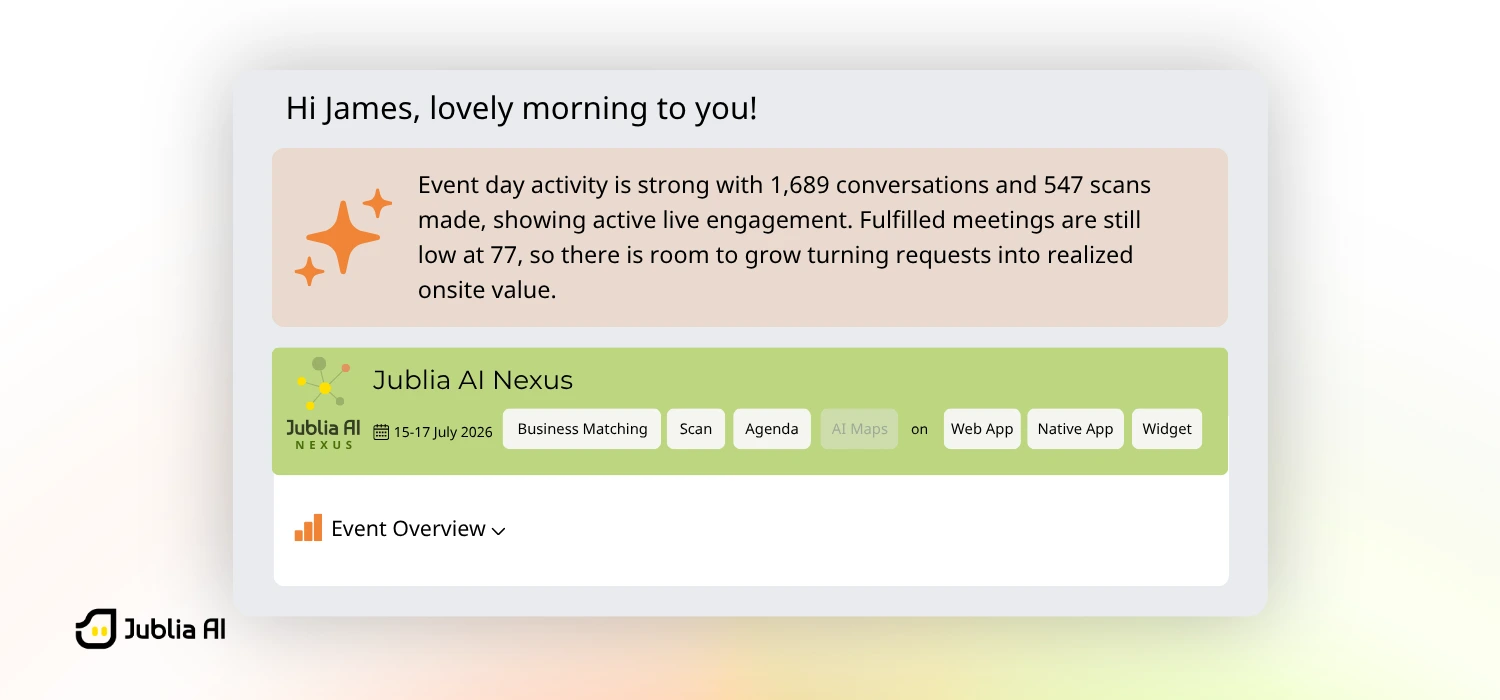
Tools such as Engagement Advisor can help organizers identify areas that need attention, while fulfillment data shows the gap between planned and completed meetings.
Ultimately, organizers may not be able to guarantee what happens after an event. But they can create an environment that better nurture relevant connections into meaningful conversations — and turn those conversations into post-event values. 

Measure the Journey, Not Just the Result

Successful event networking is built through a series of connected experiences. Quantity creates opportunities. Relevance makes those opportunities worthwhile. Fulfillment turns plans into real conversations. And the signals captured from those conversations can help point to potential value beyond the event.

Not every outcome can be measured immediately, but looking across the journey from Interaction to Opportunity to Realization gives organizers, attendees, and exhibitors a clearer picture of networking performance—and where the experience can be improved.

Want to see how this could work for your event? Talk to us about your networking goals.

Frequently Asked Questions
What does attendee behavior tell you about event engagement?
Attendee actions before an event signal what people actually care about. Bookmarking sessions, updating profiles, or skipping content all reveal intent. Organizers who read these signals can replace one-size-fits-all schedules with targeted nudges, turning passive registrants into engaged participants.
What is business matchmaking at events, and how does it work?
Business matchmaking replaces random networking with structured introductions between people who actually want to meet. It works by combining static event data with live behavioral signals like who someone bookmarks or messages. The result is meetings booked on shared intent.
What metrics matter most for event sponsorship ROI?
Sponsorship ROI starts with lead quality, not lead volume. The metrics that prove value to exhibitors are revenue-to-cost ratio, qualified-lead conversion rate, and engagement-per-sponsor onsite. Capturing these at the booth, through lead retrieval that surfaces business profile and buying intent on scan, lets exhibitors segment follow-up and prove a real return.
Written By :
Indah Ariviani
You Might Also Like
See More
Meet a Better Way to Discover What Matters at Events

Jublia AI’s upgraded Recommendation Engine makes discovery more relevant, proactive, and contextual
What’s new in Jublia AI: July 2026 Releases

Major improvements in delivering more streamlined event management for organizers and a better engagement experience for attendees

Activate your smart events today.

Let’s discuss how Jublia technologies can match your needs and budget.