
From Tools to Intelligence: Why 2026 Will Redefine the Event Tech Playbook
Insights from Jublia’s founders on what it takes to build AI-native events in 2026
December 10, 2025

If 2024 was the year AI entered the event industry’s vocabulary, 2025 was the year it entered the room — quietly, unevenly, and often misunderstood. And yet, beneath the noise, something more significant took shape: a growing awareness that AI is no longer an accessory to event technology but the foundation upon which the next decade of events will be built.
Across the industry, organizers began confronting a new reality. Innovation is accelerating at a ferocious pace, yet adoption remains uneven. Early experiments often fail, not because AI lacks potential, but because the workflows, data quality, and operations habits surrounding it have not evolved fast enough. The gap between what AI can do and what the industry is ready to do has widened — and that gap is shaping the next chapter of event technology.
The tension became clear as we prepared our vision for 2026. We wanted to understand not just how AI is evolving, but what it fundamentally means for organizers, attendees, and the future of event experiences. So towards the end of 2025, we sat down with Jublia’s founders —Yan - CEO, Errol - COO and Chinab - CTO, — for an in-depth conversation. Their perspectives, shaped by more than a decade of building technology for events, anchor the insights that follow.
The industry’s most pressing challenge is neither technical maturity nor capability — it’s readiness.
“Without question, AI innovation is moving faster than organizer adoption,” said Yan. “Downstream adoption (including the event industry) is arguably slower. While tools are being developed quickly, actual implementation is fraught with challenges.”
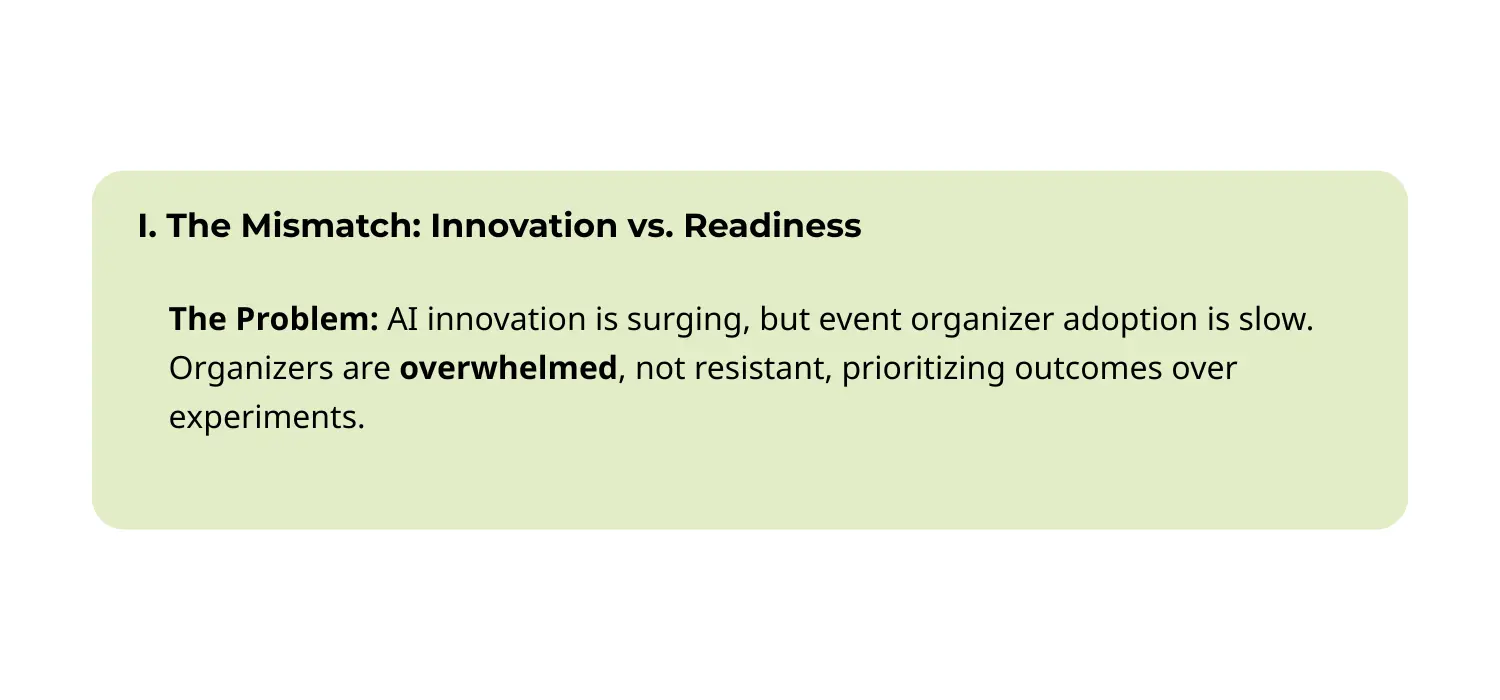
AI innovation has surged, but the event industry hasn’t moved in parallel. As Errol put it, the hesitation isn’t due to resistance; it’s due to overload. “Organizers aren’t pushing back on AI—they’re overwhelmed. They’re running 50 tasks at once. If AI adds complexity instead of removing it, they simply don’t have the bandwidth to engage.”
Yan echoed this, highlighting the misalignment between expectation and reality. “AI in events will get stronger and stronger. There’s no turning back. But organizers want outcomes, not experiments. They’re not looking for another shiny tool — they’re looking for results.”
The mismatch defines the current landscape. On one hand, AI is capable of extraordinary insight. On the other hand, many event teams still struggle with siloed data, manual workflows, and limited digital literacy.
Despite the hype, the pace of true AI adoption inside event organizations remains slow. As Chinab put it, “There is a growing discrepancy between the capability of AI and the digital literacy of the event team.” The technology is moving ahead, but the workflows and mental models inside many organizer teams have not kept pace.
Another misconception persists: AI will “fix” what’s broken.
But broken workflows don’t magically transform under automation. They scale faster. As Chinab noted, “If an event has a bad content strategy or messy data to start with, AI will simply scale that chaos faster. AI is an enabler, not a replacement.”
This perspective was echoed across the leadership team. Errol emphasized that AI should never be treated as a shortcut: “The bar for AI utility is simple: does this save time, money, or mistakes? If not, it’s noise.”
Meanwhile, Yan warned that the industry must avoid using AI as a veneer for outdated systems. “The technology means nothing if the underlying processes stay the same. AI must simplify, not complicate. It must empower, not distract.”
In other words, AI accelerates whatever foundation it sits on — good or bad. And the industry must ensure that the foundation is solid to begin with.

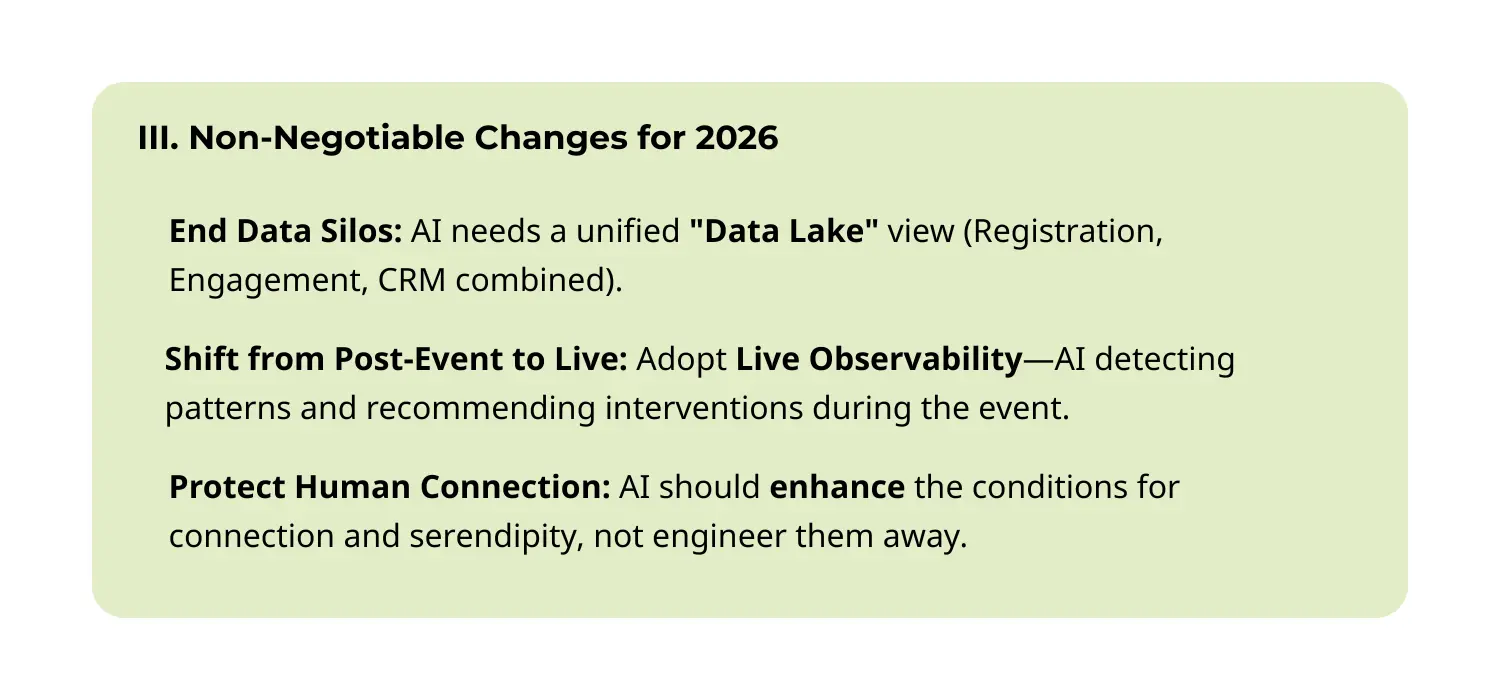
For AI to work the way the industry imagines it, organizers must retire old habits. And 2026 will be the year this becomes non-negotiable.
Chinab identifies three critical behaviors the industry must leave behind:
The future lies in live observability: AI detecting patterns, recommending interventions, and enabling organizers to adjust long before it’s too late.
Across all founders, one belief is shared: AI should enhance humanity of events, not replace it.
Chinab framed it clearly: “AI is an enabler, not a replacement. The human desire to connect is irreplaceable.”
There is a risk that hyper-optimization (matching, routing, scheduling) could inadvertently engineer away the serendipity that makes events meaningful. That risk defines one of Jublia’s most important principles for 2026: AI must never remove the magic of human discovery.
Errol added a complementary perspective, “AI won’t make a bad event good; it will only make a good event better.” This is a reminder that technology amplifies intention. It cannot fabricate community, purpose, or experience.
AI’s job is to elevate the conditions where connection happens — not to dictate it.
Trust is the cornerstone of AI adoption. Without it, the most sophisticated models will remain unused.
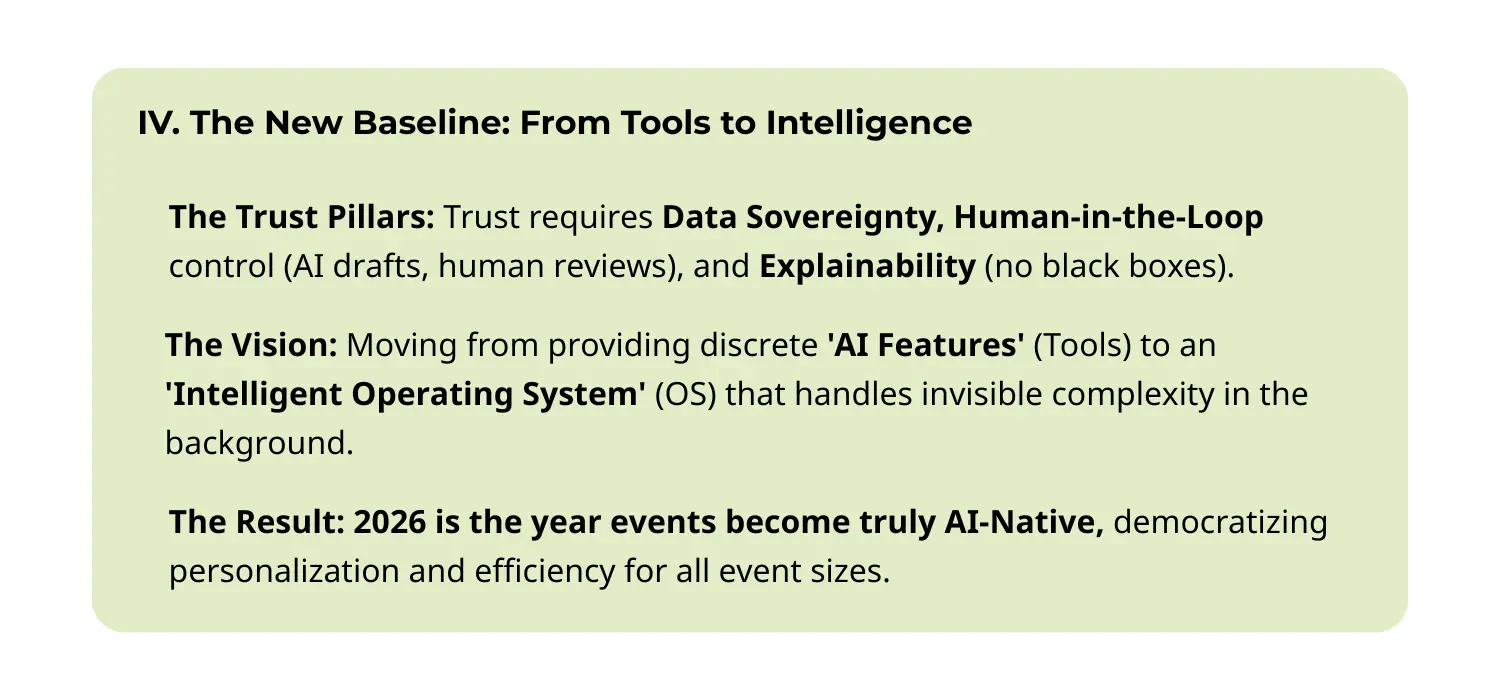
According to the founders, trust comes from three pillars:
Organizers must know their proprietary data is isolated and protected. As Yan emphasized, “Trust begins with clarity. Clients need to know their data will never train someone else’s model.”
AI should assist, not replace. “AI must be a drafter, not a publisher,” Chinab noted. The workflow should be: Train → Review → Publish, ensuring human control over the final output.
Opaque systems create anxiety. Errol stressed, “Users don’t want a black box. They want: ‘Meet John because you both operate in FinTech and interacted with the same company.’ Transparency drives confidence.”
If there is a single sentence that captures 2025, it would be, “2025 was the year we moved from playing with chatbots to building an AI framework.”
The experimentation phase is over.
2026 demands something deeper, more structural, and more integrated. The founders agree that Jublia — and the event tech ecosystem at large — must move from providing “AI features” to operating as an intelligent backbone for event experiences.
As Yan put it, “We’re shifting from building tools to building intelligence. Not an app, but an operating system that supports everything organizers do.”
This means AI agents quietly running in the background — cleaning data, enriching profiles, scoring leads, suggesting actions, detecting patterns, and orchestrating attendee journeys long before a human clicks a button.
The goal isn’t automation for its own sake. It’s reducing invisible complexity so organizers can focus on what truly matters: experience, curation, and impact.
What excites the founders the most about 2026 isn’t the technology itself, but its democratizing power.
As Errol reflected, “Small events shouldn’t be disadvantaged. AI gives them capabilities that used to belong only to massive trade shows.”
This sentiment was shared by Yan, who believes the industry is in the midst of unlocking a new standard of personalization and efficiency. “Every attendee deserves a productive journey. AI finally makes that possible at scale.”
And for Chinab, the goal is clear: “We’re moving beyond static interfaces. AI should create tailored, task-oriented experiences for every single user — without them having to fight the technology to get there.”
The future of events is not just digitized, it is intelligent.
The shift ahead is profound, but it is not abstract. It will shape how organizers structure their teams, how attendees navigate spaces, how exhibitors measure ROI, and how the industry defines success.
AI will not replace the human magic of events — but it will make that magic easier to design, deliver, and scale.
2026 isn’t about adopting AI, it’s about becoming AI-native.
Becoming AI-native isn’t just a strategic choice—it’s the new baseline for creating event experiences that feel intuitive, connected, and intelligently orchestrated. And as we move toward our next chapter, we’re inviting forward-thinking organizers to take the first step with us.
Explore what Jublia AI will bring in 2026 and join the pre-launch list to be the first to experience the new era of AI-native events.


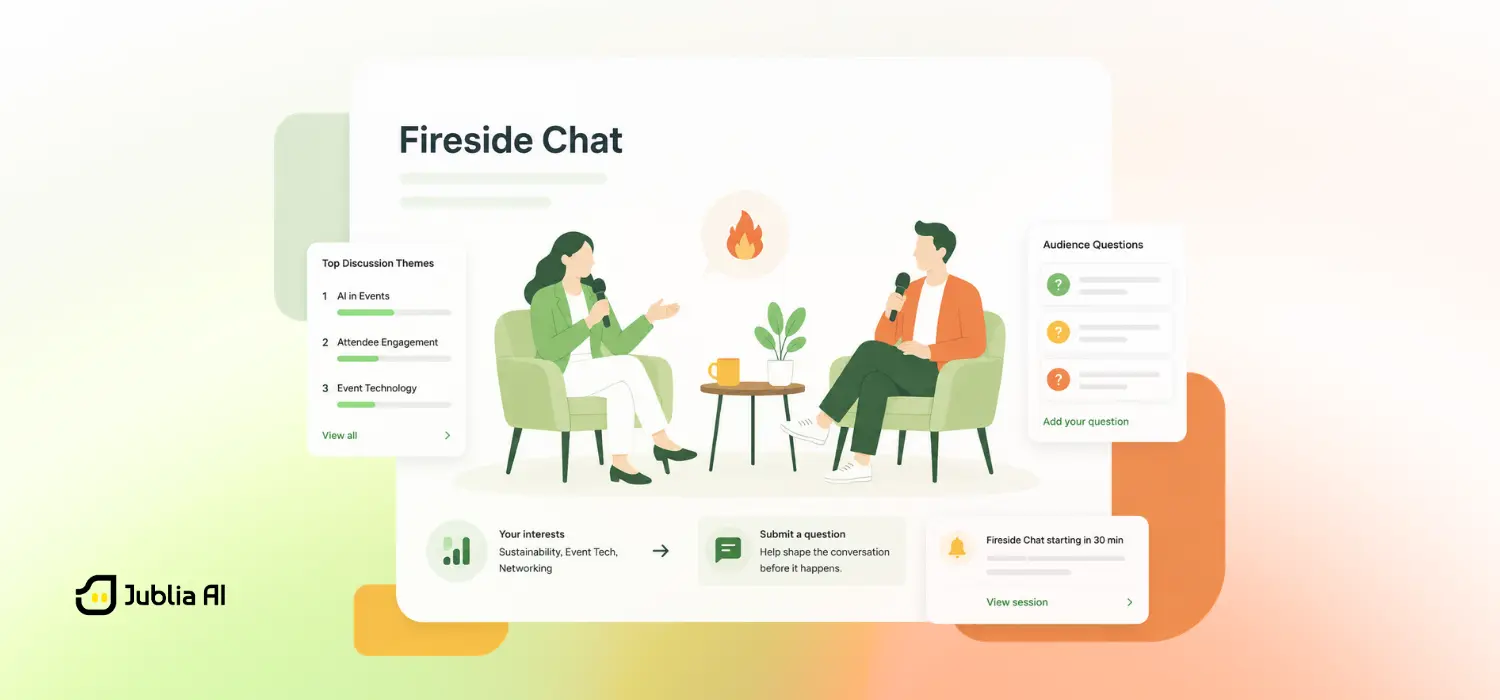 How to Drive Engagement at Business Events with Fireside Chats
A great fireside chat isn't just interactive, it responds to attendees’ burning questions about what matters most to them
 Micro-Events: How They Can Be the Next Addition for Your Event Strategy
There’s a growing demand for more intimate networking, but does it fit into your event portfolio?
 The Communication Engine: Orchestrating Event Engagement with Jublia AI’s Concierge Delivery
Engagement doesn’t happen on its own — it’s designed


.gif)
%201.png)
%201.png)
%201.png)
--p-2000.webp)
%20Black-Black%20Eyes.gif)


.png)